A Close Look at Our Collections Journey Again!
The Collections Journey continues to progress; our team of volunteers and staff has now cataloged an astounding 1,500 museum objects! That is a huge number of items that have passed through multiple steps to become officially cataloged in our online system, eHive. That would not be possible without the team who dedicates time each week to cataloging the Wee Museum of Memory’s collection. Most of our team are volunteers, from those of us coordinating and leading the effort to each of us processing every individual object through the process. While the Collections Journey could not progress as it does with the volunteers, the journey itself provides amazing work experience and learning for volunteers. The museum world can be incredibly hard to break into. The volunteer program at the Wee Museum of Memory allows for volunteers to get meaningful, informed, and hands-on experience with museum cataloging, incredibly important experience for anyone looking to work the behind the scenes at any museum.
These blog posts have now covered three steps in the cataloging process so far: Treasure Hunt, Acquisition Creation, and Photography. The next step to explain is Cataloging. Though the entire process is called cataloging, this individual step is also called Cataloging; it is the most in-depth and arguably the most important step in the process. Now that the acquisition has been created and photos taken, the volunteers completing the Cataloging step already know what the object is. However, now each object has to be given an online record of its own. On this online record, volunteers fill out the object title, the object description, the year it was made, the place it was made, who made it, its materials, condition, and more (that is all called metadata). Some of those categories take a lot of research to fill out, so the Cataloging step often involves a lot of research to determine the correct information about each object.
The Concorde Flew From Edinburgh to Paris?
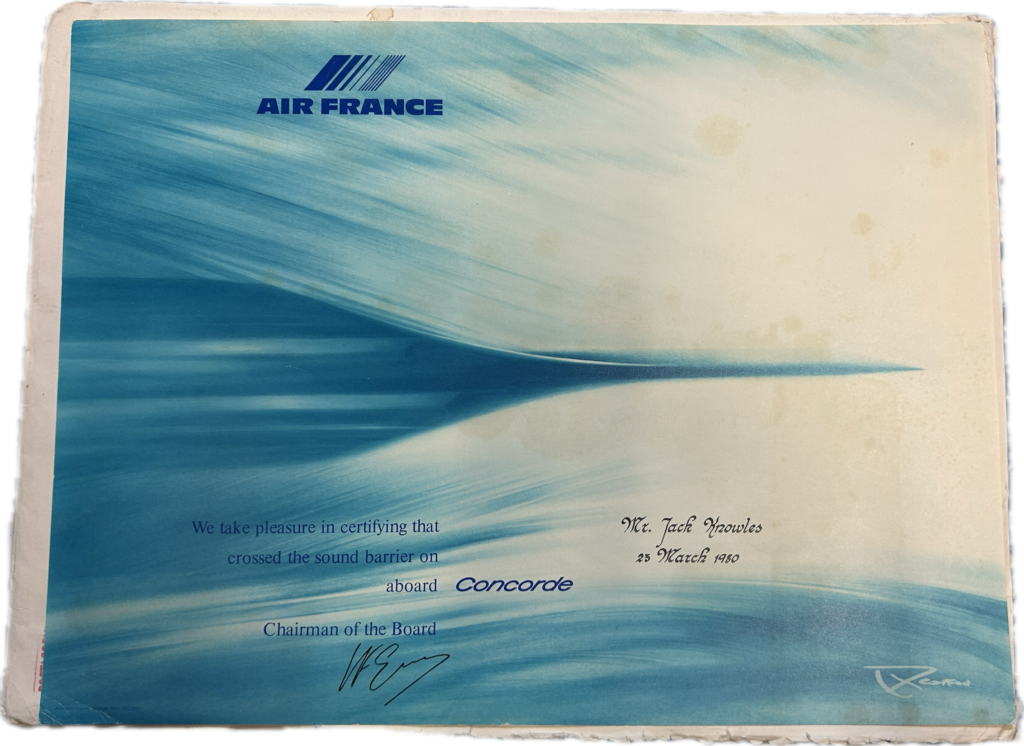
On the 21st of January 1976, two groundbreaking commercial jets, known as Concorde, flew from Paris to Rio de Janeiro and from London to Bahrain. These two flights, the first of their kind, transported their passengers at supersonic speed. Concorde would become a hallmark of the advancements of the modern world, an embodiment of human progression rocketing toward the turn of the century. Famously, Concorde could fly between London and New York in as little as 3 hours and 15 minutes, an insanely fast speed, much quicker than the trips flown even now in 2026, which take around 7 hours and 30 minutes. Because Concorde flew faster than the Earth’s rotation, a flight leaving London at breakfast time could reach New York before breakfast time, meaning passengers could have two mornings on the same day. It was a monumental achievement for commercial flight, something recognized by the airlines, British Airways and Air France, and passengers alike, who were given a certificate of flight for each journey to prove they had flown faster than the speed of sound aboard Concorde. The image above shows one of these certificates; it shows the name of the passenger and the signature of the Air France Chairman of the Board. This certificate is held by the museum as part of a package of documents, given to Mr. Jack Knowles, a passenger, that relate to the first Concorde flight between Edinburgh and Paris.
Though the Concorde flight between London and New York is famously well known, some of its other flights are a little less known. Though we had heard of Concorde, we assumed it only flew between London, New York, and Paris. That Concorde took flight from Edinburgh Airport was news to the volunteers cataloging these documents, who were surprised to see that the Concorde came to Edinburgh.
“Concorde flew from Edinburgh to Paris?!”
The documents in the Wee Museum of Memory’s collection clearly show that Concorde made a trip from Edinburgh to Paris. In fact, our collection includes the official flown cover of the Edinburgh-to-Paris Concorde route, flown on the 23rd of March 1980.
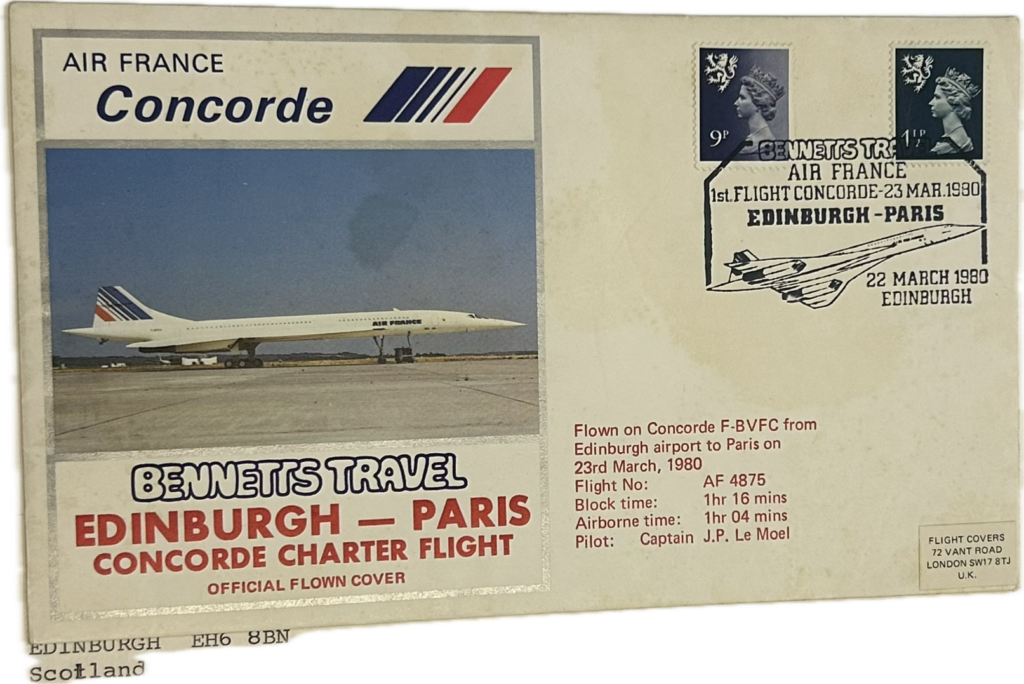
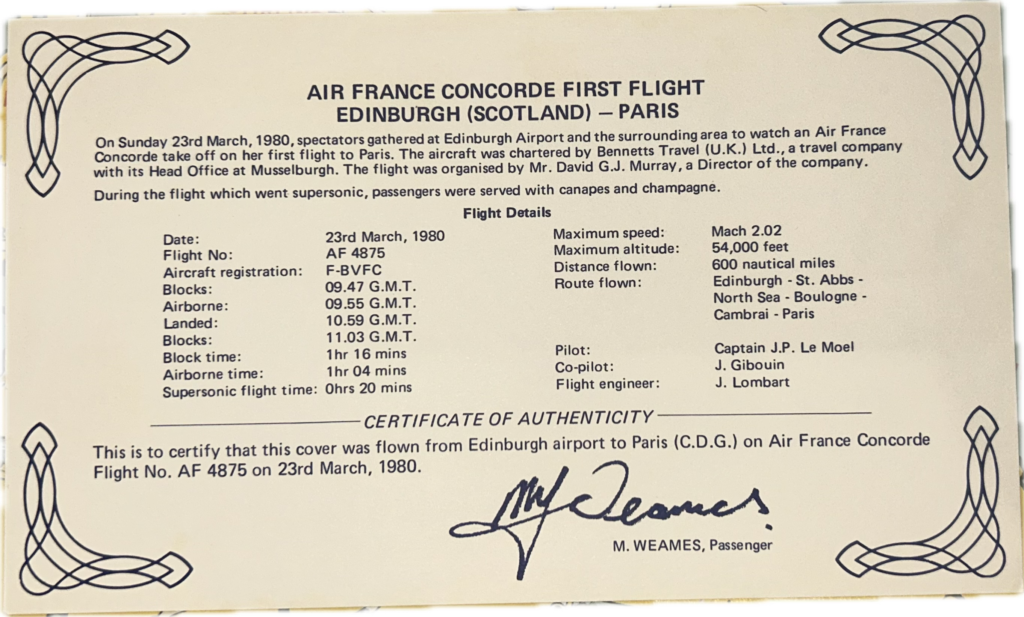
First Flight Covers are envelopes carried on a new route’s first journey and are designed to inaugurate or commemorate a new route or new advancement in aviation. The First Flight Cover held by the Wee Museum of Memory was carried aboard the 23rd of March 1980 Concorde flight from Edinburgh Airport to Paris Charles de Gaulle, a journey that took 1 hour and 4 minutes. On today’s flights, this journey takes about 2 hours. This was a charter flight, organized by Bennet’s Travels, a travel agency operating out of Musselburgh, and was organized as a one-off novelty trip.
Concorde flights were marketed as a luxurious experience, rather than just a mode of transportation. According to the flight cover, the Bennetts Travel flight served champagne and canapés during its hour-long journey.
And luxurious and expensive, they were. Not only for the passengers but for the airlines running Concorde as well. The supersonic jets used an enormous amount of jet fuel to operate, more than double the amount used for normal flights.
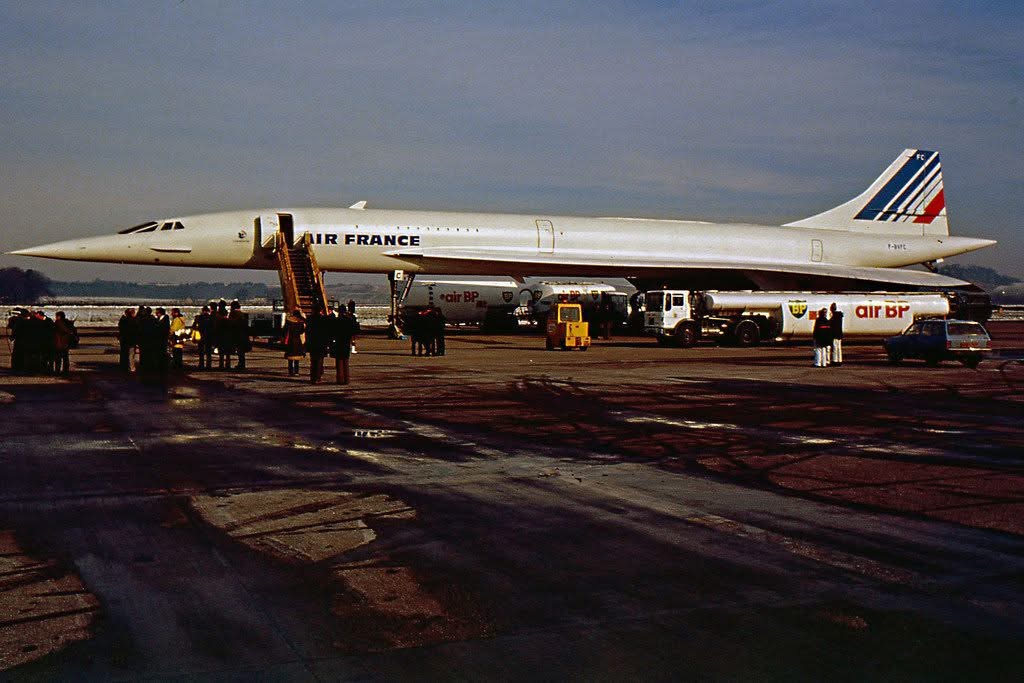
The Air France Concorde aircraft flown from Edinburgh Airport to Paris through Bennetts Travel
The exorbitant amount of jet fuel burned during these flights is one of the main reasons they no longer operate. As fuel prices rose in the last decades of the century, the cost of the fuel needed to operate the aircraft exceeded the profit; Concorde was no longer a smart investment for airlines.
The supersonic capabilities of Concorde were also heavily restricted. The sonic boom that the aircraft created when jumping into supersonic speed was powerful enough to shatter glass on the ground. Therefore, the aircrafts could only go supersonic over the ocean. You can see how this affected the practicality of the aircraft by looking at the flight cover we have at the museum. Of the 1 hour and 4 minute flight, only 20 minutes were actually flown at supersonic speed. The Bennets Travel flight flew from Edinburgh over St. Abbs and then out across the North Sea, doing a wide curve down toward France rather than flying directly down over North England and the English Channel, likely because this allowed them to travel at supersonic speed while over the North Sea. This kind of special route needed to facilitate supersonic speed was simply not practical and was a huge reason this flight had to be chartered as a novelty; Edinburgh to Paris was not a repeating route, and that Concorde eventually stopped flying – it just wasn’t practical.
Finally, Concorde had a terrible crash on the 25th of July 2000 involving debris that punctured a tire and caused a fire in the fuel tank that led to the deaths of 113 people. Concorde was grounded for a year to fix the issues that led to the crash, and during this year, 9/11 caused a worldwide decline in air travel. Concorde was never able to recover and the fleet was retired in 2003. Though Concorde did not regularly operate out of Edinburgh Airport, during its farewell tour in 2003, the fleet made one of its few stops at Edinburgh Airport. Click here to read the original The Herald news article about the farewell stop in Edinburgh.
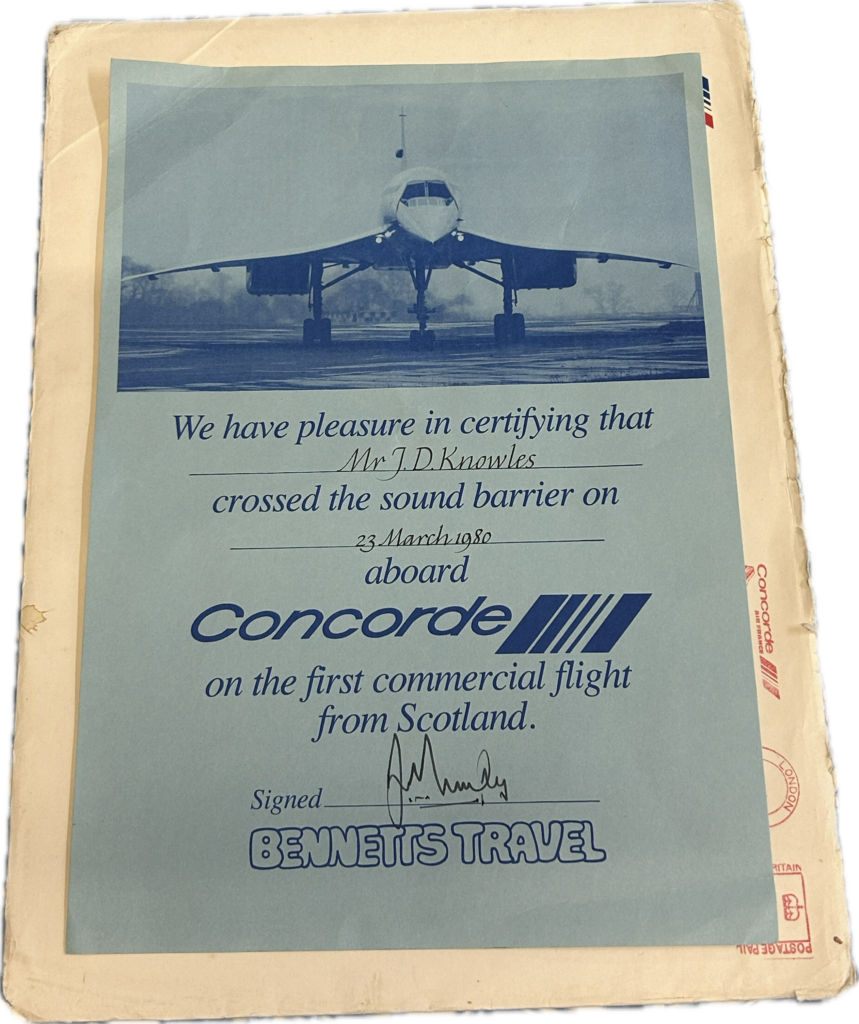
Despite its eventual failings, Concorde was heralded as a symbol of human advancement in the ever-evolving world of the late 20th century. The fact that these documents have survived over four decades inside their original envelope shows that passengers, like Mr. Knowles, to whom these documents originally belonged, held the experience of travelling faster than the speed of sound aboard such a feat of engineering in high regard. Despite the impracticality of a flight from Edinburgh to Paris, flying aboard Concorde meant you were undeniably a part of the technologically advanced modern world, a part of progression. Edinburgh’s residents wanted to, and were willing to pay, to be part of this modern progression, rocketing toward the turn of the century.

Want to explore our collections?
If you want to explore the Concorde documents and other objects that we have finished cataloging, they’ve been uploaded online and made available to the public. Click the link below to see them!
If you’d fancy seeing some of our objects in person and fancy spending some time reminiscing about the past, come by the Wee Museum of Memory, located in Ocean Terminal. Entry is free, and we are open from 10:30 am to 4 pm on weekdays and from 11 am to 4 pm on weekends!